

What is Low-Code?

 An introduction to custom software development with Low-Code.

Legacy software budget

Reading time: 2 minutes 

Lowcode is a modern approach to software development that enables applications to be built with minimal handwritten code. Instead of writing thousands of lines of traditional programming languages, developers and nondevelopers work with visual tools, draganddrop components, and prebuilt logic to create applications faster and more easily. 

Lowcode platforms are designed to reduce dependency on specific expertise and as a result speed up delivery, without sacrificing control, scalability, or customisation. Therefore the governance is managend, and the team can focus on building software and relieves client teams with setting up custom security. Low-code sit squarely between nocode tools (which require almost no technical expertise but have limitations) and traditional highcode development (which offers maximum flexibility but is slower, more expensive, and resourceintensive). 


In this article, you’ll learn:

  • What low‑code is and how it compares to no‑code and traditional development
  • How the industry defines low‑code and why it is a mature, proven approach
  • How low‑code evolved and where it fits in today’s technology landscape
  • How CAPE defines low‑code as a strategic, enterprise‑ready delivery model


    How the Industry Defines LowCode 

    By leading research and technology organisations such as Gartner, Forrester, Microsoft, and IBM, lowcode is defined as: 

    A visual, modeldriven approach to application development that reduces manual coding while enabling speed, reuse, scalability, and governance. 

    This shows that lowcode is not a shortcut or a temporary trend, it is an established and mature development approach. 


    History of LowCode 

    For some, the term lowcode may sound new, while for others it represents a familiar and longstanding concept. Much like software engineering or project management, the underlying ideas behind lowcode have existed for decades—long before the terminology itself became commonplace. 

    Visual and model‑driven development approaches date back to the 1980s and 1990s, with technologies such as CASE tools (Computer‑Aided Software Engineering), fourth‑generation languages (4GLs), and Rapid Application Development (RAD) frameworks. These approaches already aimed to reduce manual coding and accelerate application delivery, demonstrating that the core principles of low‑code are not new. 

    The term “low‑code development” first appeared in industry research around 2011, when it was referenced in analyst reports by Forrester Research, including work by analyst Clay Richardson. However, it wasn’t until 2014 that lowcode was formally introduced as a distinct category and began gaining widespread adoption across the industry. 

    Around this time, major analyst firms such as Forrester and Gartner started to define and structure the market by introducing low‑code vendor quadrants, helping organisations compare platforms and accelerating awareness and adoption of low‑code as a mainstream development approach. 
    Evolving Terminology in the LowCode Space 

    In the early 2010s, low‑code emerged as the new “must‑have” technology, attracting widespread attention largely because it promised faster delivery and reduced dependency on scarce development skills. At that time, many organisations adopted low‑code simply because it was new and positioned as a breakthrough in software development. 

    As the decade progressed, the term “citizen development” gained prominence within the low‑code space. The idea was to enable non‑technical users to build applications themselves, reducing pressure on IT teams. While this concept generated significant hype, it gradually lost momentum after several years. Many platforms moved away from emphasising citizen development, as the narrative increasingly shifted toward no‑code—a direction that focused more on simplifying development rather than enabling more advanced or enterprise‑grade use cases. 

    By the early 2020s, no‑code platforms gained traction and captured part of the market that had previously belonged to low‑code. At the same time, low‑code solutions continued to evolve. Early limitations—such as restricted processing power, limited front‑end capabilities, and weak offline support—were progressively addressed. As a result, modern low‑code platforms matured into robust environments capable of supporting complex, custom software solutions. Today, low‑code remains a significant and competitive force in the custom software development market. 

    In parallel, many large SaaS vendors introduced “low‑code” capabilities as part of their existing offerings. Rather than independent development platforms, these tools allow users to configure or extend standard software products. Examples include Salesforce, SAP, and IBM, all of which have used low‑code terminology extensively. While these tools empower users with additional flexibility, they typically require prior knowledge of the underlying platform and operate on top of an existing license rather than as standalone solutions. 

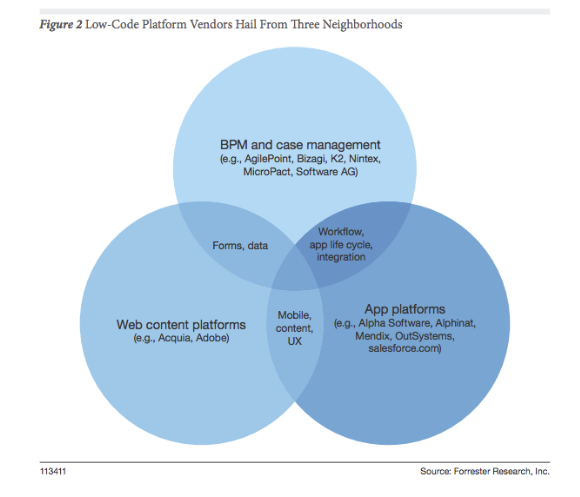
    Another important shift over recent years is the convergence of platform categories. In the 2010s, analyst firms clearly differentiated between web content platforms, Business Process Management (BPM), case management solutions, and general application platforms. Today, these boundaries are increasingly blurred—especially between BPM, case management, and application development—resulting in broader, multi‑purpose platforms. While this convergence increases flexibility, it also makes it more challenging for customers to clearly understand where and how these platforms are best applied. 


    Low-Code platform vendors
    Legacy software budget

    How We Define and Use LowCode at CAPE 

    At CAPE Digital Solutions, we align with the industry definition, but we go a step further. For us, lowcode is not just a platform choice, it is a strategic delivery model. 

    We define lowcode as: 

    “A development technique that uses a visual interface and preprogrammed building blocks to rapidly create powerful applications that digitally support and optimise business processes.” 

    Technology itself doesn’t create value. How it is designed, governed, and embedded into your organisation does. 

    In the next article, we move from definition to execution. You’ll explore what low‑code development looks like in real projects, how it accelerates delivery without compromising quality, and how it bridges the gap between business and IT.


    Let’s connect! 

    If your organisation depends on legacy software, the real challenge is not whether it still works,  but whether it can continue to support your strategic, operational, and regulatory objectives.

    CAPE helps organisations assess, stabilise, and modernise legacy environments with a clear understanding of risk, cost, and business impact. We work with you to define the right path forward, whether that’s extending the life of an existing system, reducing risk, or preparing for modernisation at the right moment.

    Get in touch with our consultants to gain clarity on the current state of your legacy systems and the options available to you.


    Harmjan-CAPE digital solutions

    Harmjan Oonk