

The world is rapidly changing, and so is the world of developing software solutions. Traditionally you always needed a team of IT developers to build software in languages you could never understand. Nowadays, multiple solutions exist to create software without even writing one line of code. In this article, I will explain what types of code exist to create software solutions. We’re also answering the question: what is the best type of code? No-code, low-code or high-code?
4 minutes read, by Harmjan Oonk
Author of the blog:

Harmjan Oonk


Example: Highcode car
Let’s say you want to develop a car. With high-code, you can determine every step and customize it. You can design a light vehicle with solar panels. You can decide which type of materials you’ll use, the look and feel of the car, or skip some parts and design. However, you need a lot of expertise to build this solar car. You need knowledge about solar panels, as well as an engine, batteries, materials, interiors etc. You need to bring in all of the experts to manufacture the car. However, you can influence and adjust every step to your needs.
Advantages:
- You don’t need to learn a programming language to create applications. Anyone using a computer and a no-code tool can make software applications or adjustments in existing software tools with no-code options.
- You don’t depend on IT professionals or the IT department. You can make the solutions yourself.
- You can deliver new features for most no-code solutions within minutes.
- You don’t need the experience to maintain software or know how to set up an application. You can rely on the no-code solution.
Disadvantages:
- Your only options are the prefabricated components. If your needs extend beyond what the platform provides, you are stuck.
- Performance could be an issue when working with thousands of users. Performance is also affected when having to process large amounts of data.
- You cannot influence the building process.

Example: no-code car
You want to build a car. Think about a car configuration tool. For every component, you have choices, but these are predefined. You just have to click on the option box. There is no need to worry about the design, realization or delivery. Everything is done by the no-code tool, but you’re limited to the predefined building blocks. If you click ‘build’, the no-code tool will ensure the car is manufactured. You cannot adjust or see this process.

Advantages:
- You can create software lightning fast with predefined building blocks.
- You don’t need to be a programmer to learn new features or functionalities. A citizen developer can build software since the low-code tool guides the citizen developers.
- You can customize specific areas fit to your requirements. However, you need the expertise to be able to do this. This customization can be done by a citizen developer.
- You don’t need experience in order to maintain software or know how to set up an application. You can rely on the low-code solution.
Disadvantages:
- You need some understanding of coding to use low code and deliver customized features.
- You need to work within the boundaries of the low-code platform.
- You need expertise with low-code tools to build high-performing applications.
Example: Low-code car
You can still use the car configurator tool with low-code. You can select the frame, type of wheels and engine type. However, if you want to add a feature, you can.
Consider using a body kit, a spoiler, or a turbo for your engine. You can install it on your car, but you need some additional knowledge to integrate it correctly. Therefore it is adjustable to your needs, but limited to the car type and availability. So it’s a combination of high-code & no-code. In the end, you can extend low-code with high-code. However, this means that you still need experts with high-code knowledge to customize parts fully.
Good to know
Many software manufacturers say they have low-code solutions. Think about SAP or SalesForce. They offer their products and let users adjust the platform with no-code or low-code modules. This is low-code and no-code, but you cannot make a fully standalone no-code and low-code solution with SalesForce & SAP. They always rely on the core product, in this case, SAP or SalesForce.
Technologies like Mendix and OutSystems are standalone enterprise low-code application tools that enable the business to create an application without this core product. Therefore, you don’t need to rely on a software vendor. You can build anything and integrate it with other applications.
What is the best type of code?
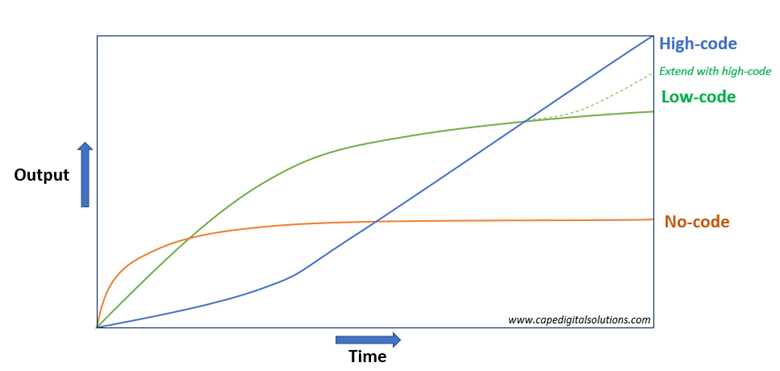
This question is problematic, as it depends on your use case or scenario. To give you a brief answer, I made a diagram to show the best code type based on the complexity and knowledge required.
High-code is the way to go if you want a fully customized solution. But remember that you need a lot of expertise to build solutions. Secondly, you must maintain this knowledge if you constantly want to update and maintain your solutions.
Again, it all depends on what the code will be used for. If you want to gain a competitive advantage, you need highly customizable solutions. Therefore, high-code or low-code could be your choice. However, if you have difficulty finding people, low-code or no-code could help you since people with limited IT knowledge can build applications.
You could choose no-code solutions if you wanted to use basic features and let anyone add features to your applications. In the example given earlier with the website built with WordPress, the no-code solution works for 80% of the cases. Low-code can be a good alternative if you want to use the advantages of both high-code and no-code. Low-code has the benefits of a no-code team but still gives you the flexibility to make nearly anything you could think of.
What is also an important thing to consider is that technology isn’t the solution. In the end you need the right approach to implement the technology. Therefore, you require the correct method and mindset.
In the following article, I will write about specific systems and when you want to consider no-code, low-code or high-code. If you want to receive these articles by mail, please subscribe to our newsletter below.
Need any help?
Do you need assistance with preparing your business for the future? We’re happy to help and ensure you’re ready for the future. Feel free to contact our Australian team lead Harmjan.
Harmjan Oonk
More articles

Forget Gold and Diamonds
Articles Forget Gold and Diamonds - Feedback Is the Real Treasure Mendix Mini survey In this blog What are Mini Surveys? How to implement Mini Surveys A small plot twist… Final Thoughts More mendix tips If you’re building applications, you...

Online-First, Offline-Smart: 4 Lessons learned from a Hybrid Mendix App
Building an app that’s mainly online but needs to handle a few tasks offline presents a unique challenge. You probably don’t want the complexity of a fully offline-first architecture if, 95% of the time, the app is being used while having a stable internet connection.

Learning of the Month: The Business & IT Gap — Don’t Fall for It
Teams move fast, features get built — but are we solving the right problem? In this blog, Harmjan Oonk explores how assumptions sneak into projects and why involving end-users early is key to building software that actually delivers.