
Reading time: 2 minutes
Low‑code is a modern approach to software development that enables applications to be built with minimal hand‑written code. Instead of writing thousands of lines of traditional programming languages, developers and non‑developers work with visual tools, drag‑and‑drop components, and pre‑built logic to create applications faster and more easily.
Low‑code platforms are designed to reduce dependency on specific expertise and as a result speed up delivery, without sacrificing control, scalability, or customisation. Therefore the governance is managend, and the team can focus on building software and relieves client teams with setting up custom security. Low-code sit squarely between no‑code tools (which require almost no technical expertise but have limitations) and traditional high‑code development (which offers maximum flexibility but is slower, more expensive, and resource‑intensive).
In this article, you’ll learn:
- What low‑code is and how it compares to no‑code and traditional development
- How the industry defines low‑code and why it is a mature, proven approach
- How low‑code evolved and where it fits in today’s technology landscape
- How CAPE defines low‑code as a strategic, enterprise‑ready delivery model
How the Industry Defines Low‑Code
By leading research and technology organisations such as Gartner, Forrester, Microsoft, and IBM, low‑code is defined as:
A visual, model‑driven approach to application development that reduces manual coding while enabling speed, reuse, scalability, and governance.
This shows that low‑code is not a shortcut or a temporary trend, it is an established and mature development approach.
History of Low‑Code
For some, the term low‑code may sound new, while for others it represents a familiar and long‑standing concept. Much like software engineering or project management, the underlying ideas behind low‑code have existed for decades—long before the terminology itself became commonplace.
Visual and model‑driven development approaches date back to the 1980s and 1990s, with technologies such as CASE tools (Computer‑Aided Software Engineering), fourth‑generation languages (4GLs), and Rapid Application Development (RAD) frameworks. These approaches already aimed to reduce manual coding and accelerate application delivery, demonstrating that the core principles of low‑code are not new.
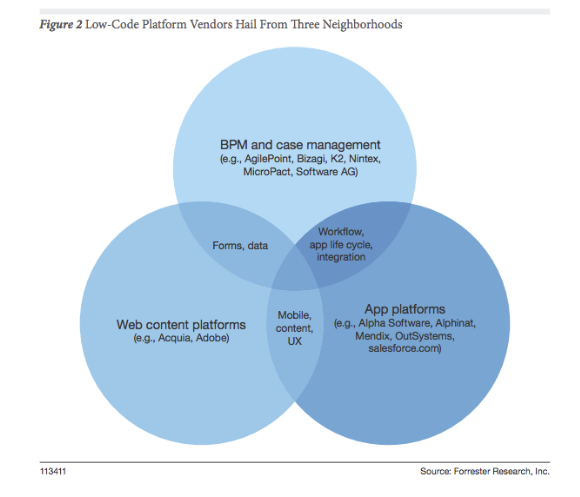
The term “low‑code development” first appeared in industry research around 2011, when it was referenced in analyst reports by Forrester Research, including work by analyst Clay Richardson. However, it wasn’t until 2014 that low‑code was formally introduced as a distinct category and began gaining widespread adoption across the industry.
Around this time, major analyst firms such as Forrester and Gartner started to define and structure the market by introducing low‑code vendor quadrants, helping organisations compare platforms and accelerating awareness and adoption of low‑code as a mainstream development approach.